Bob Munden (1942-2012) is still acknowledged to have been the fastest draw who ever lived, able to draw and fire a six-gun in 200 milliseconds. Clint Eastwood is said to have been the third fastest gun among Hollywood actors (oddly, Jerry Lewis and Dean Martin ranked 1st and 2nd), but none were as fast as Bob Munden. However, Munden was much slower than the wood stork. The wood stork is believed to have the fastest reflex (closing its open mouth) among all vertebrates. Rare among birds, the wood stork hunts not by sight but by touch. It opens its long beak in shallow water waiting for a fish to brush against it before snapping it up in just .25 milliseconds (the human eye takes 200 milliseconds to blink).
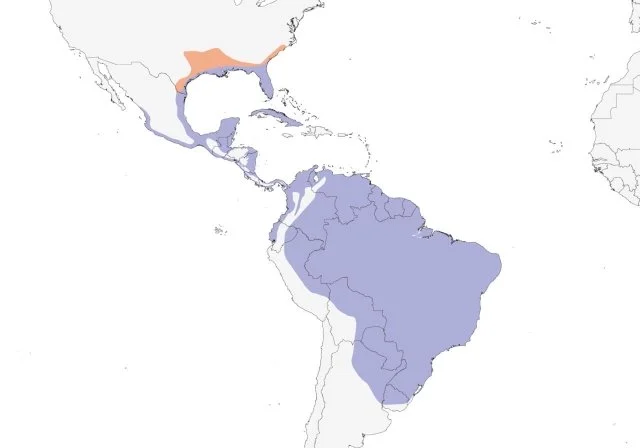
Wood stork range
Wood storks are majestic and beautiful in spite of their naked head and neck. Second only to great blue herons as the largest wading bird in North America, wood storks are the only storks that breed in the United States. Their range in the United States is mostly across southern Florida though breeding may occur further to the north as the climate warms. Wood storks nest communally in trees surrounded by water. But even when nesting conditions seem ideal, they prefer nesting sites with alligators present. The alligators protect the nestlings from predators by discouraging racoons and other animals.
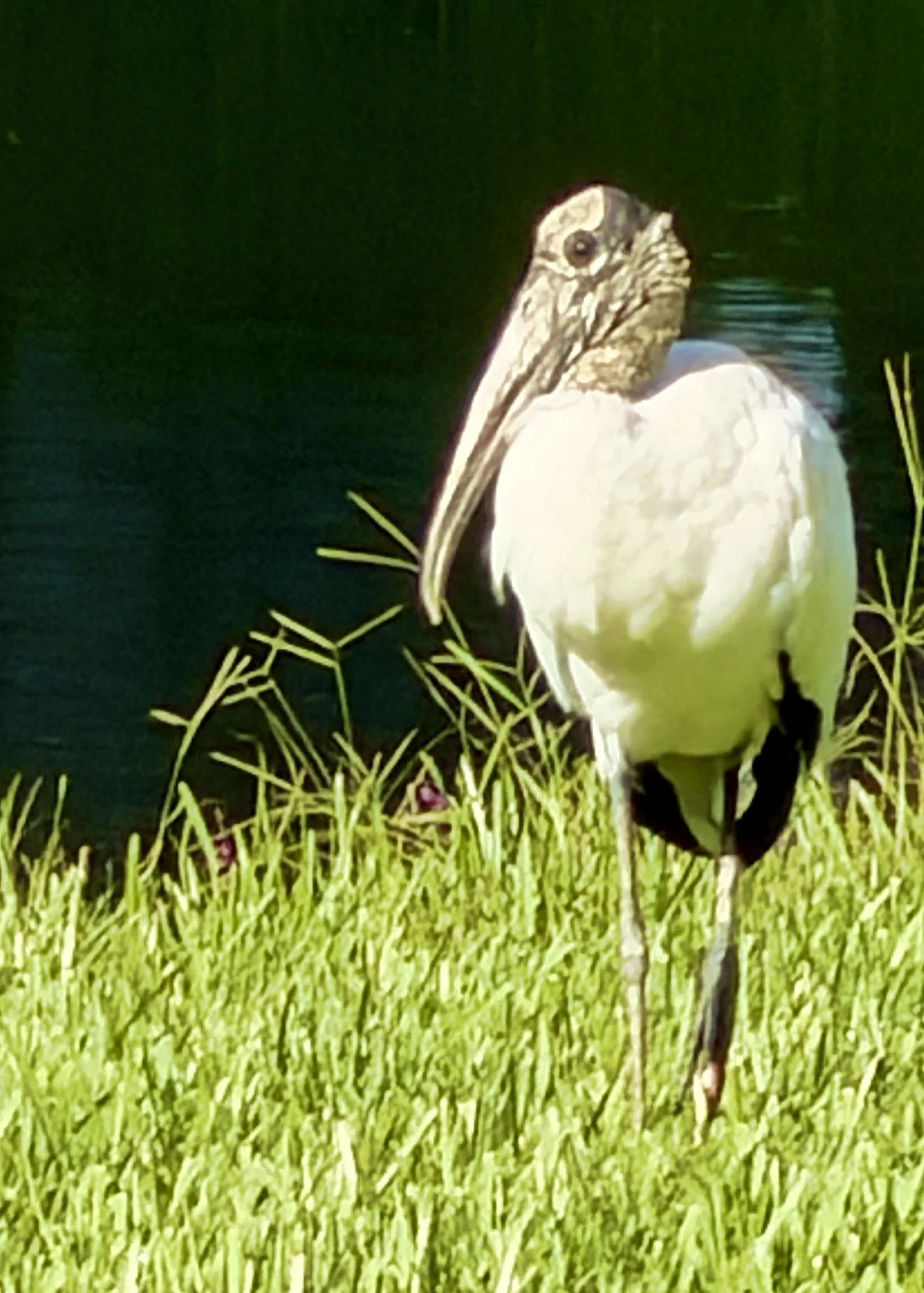
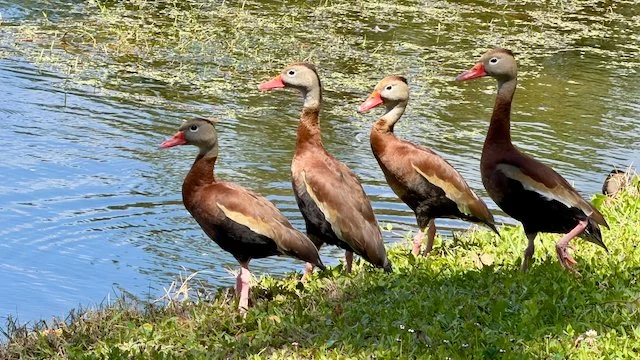
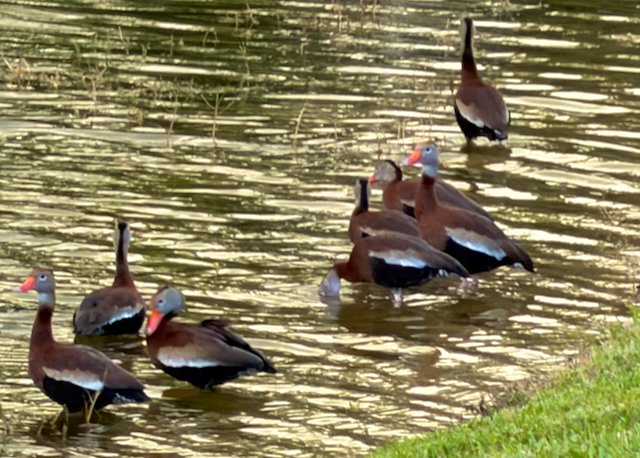
I have recently written about whistling ducks and laughing gulls. Adult wood storks, however, are largely mute. As nestlings, they loudly demand food from their parents, but upon leaving the nest they gradually lose their voices.
Since adult wood storks are mute, their discussion groups are quiet affairs
This Morning When You Left the Porch
by
Susan Rooke
In those few early moments
when you went indoors to pour
more coffee, to refill your cheery
yellow mug with the blue cat
on the front, pouncing
on the blue mouse . . .
While I stayed outside watching
pink heavens hinting at
the yellow-and-blue day on the rise . . .
That was the one time
Wood Storks chose to ornament
our humble square of sky, the one time—
perhaps in your life—
you had the chance to gasp at
the broad white bodies, the elegant
white wings—black-trimmed—
sailing our mild inland winds
on their way to someone else's sky,
the naked, grey-skinned necks and
down-curved bills extended, probing
the universe for its sweet spot.
But you missed it.
My mug, though—
plain and smooth and white
as cloud, as a Wood Stork's breast—
my mug was full.
I saw. And I gasped.
Loudly enough for both of us.