
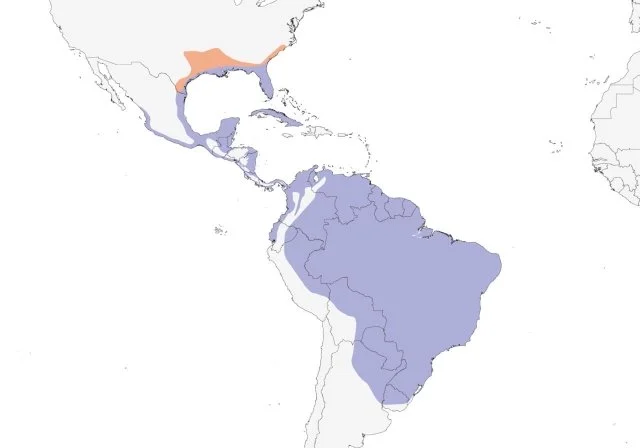
The range of the anhinga
Among the Brazilian Tupi people, devil bird or snake bird is translated to anhinga. And so came the name of one of the more interesting though maybe a bit sinister-seeming birds to be found in (southern) North America as well as points south.
The anhinga, like the commorant, lacks waterproof feathers, which facilitates its ability to dive more deeply to catch fish. While swimming on the surface, its entire water-logged body except for its head and neck is submerged causing it to resemble a snake in the water. Able to remain submerged for up to two minutes, it spears its prey with its sharply pointed, lethal beak. Upon returning to the surface, the anhinga will flip its lunch in the air and catch it in its mouth.
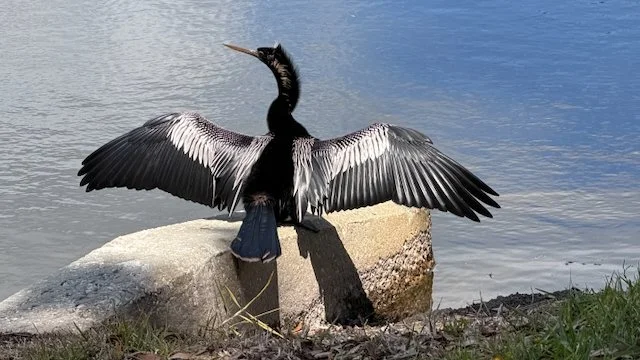
When the anhinga emerges from a fishing expedition, it will, like the commorant, stand with wings and tail feathers spread until they dry in the sun. Here’s a 1-minute video to give you a better picture of the anhinga’s lifestyle.
As readers here may know, I am fond of concluding with a short poem or song related to the current topic. I couldn’t find a suitable anhinga poem, but you may be interested in knowing about Anhinga Press, which was founded in 1974 in Tallahassee, Florida, with a mission “to bring quality poetry to a broad audience.” There is even an annual Anhinga Prize for Poetry established in 1983. It warms my heart a little that a bird known as the “snake bird” and the “devil bird” can have inspired an organization with such a devotion to the cultivation and spread of fine poetry.
Addendum: In case you have trouble navigating from the comment below, I am adding a link to a very short poem and beautiful artwork titled “Anhinga” by Michelle Kogan. In a few lovely words and brush strokes, it belies the myth of the “devil bird.”