
I have a very loud whistle using two fingers against the underside of my tongue. I learned this by practicing while delivering morning newspapers (Peoria Journal Star) from my bicycle at age 12. Mind you, it was between 4 and 5 AM. So when I mastered the whistle, I am now not certain how happy my customers were to have their arriving newspaper heralded in this manner. Nevertheless, it has been a useful skill on many occasions since. But if it whistles like a duck…
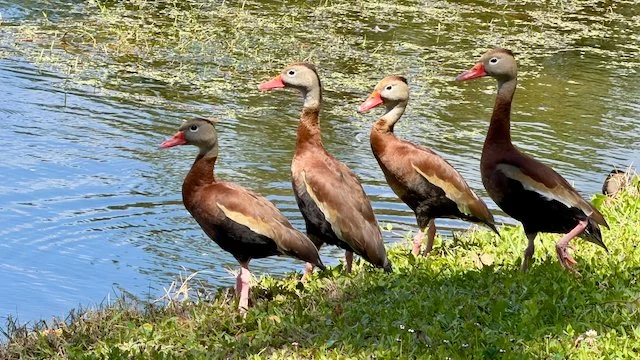
It must be a whistling duck, a black-bellied whistling duck in this case. I don’t think young whistling ducklings need to practice to acquire this ability. However, knowing the contorsions of my tongue, lips, and fingers required for me to learn to whistle, it’s hard to picture mastery of this skill with a large flat duck bill instead of lips. Quacking seems easier. But have a listen (and a look). By the way, if it quacks it is probably a duck, and most likely a female duck since male ducks don’t quack.
Black-bellied whistling ducks are found in central South America as well as Central America and coastal Mexico. In the US they are most likely to reside on the gulf coast of Florida. However, their range has been steadily moving northward with a lone whistler turning up in Wisconsin recently. They have also been known as tree ducks because of their ability to roost and nest in trees (not unlike wood ducks). Whistling ducks actually look more like geese with their long necks and legs and resemble them in their sexual dimorphism (males and females look alike) and their long-term pair relationships.
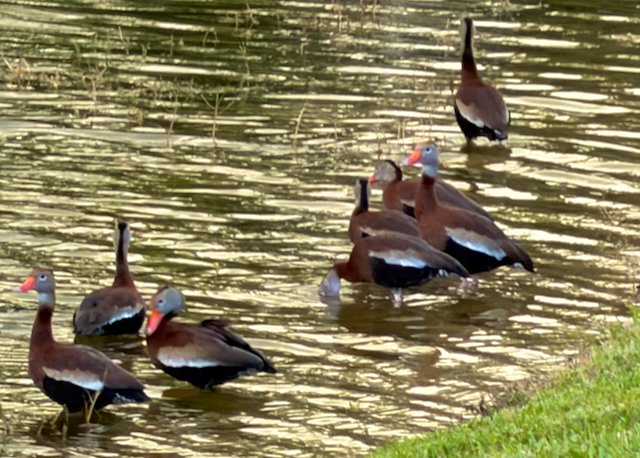
Pink beaks and pink legs give these (male and female) ducks a playful, if not somewhat gaudy, appearance as if wearing hot pink tights and coral lipstick. Pretty suitable since they prefer to forage at night and maybe take in the local club scene before roosting all day. They tend to hang in large and noisy flocks (all that whistling).
I couldn’t find a poem about whistling ducks, but here’s a sweet prose poem about another long-term pairing by Mary Oliver that will do.
"The Whistler," by Mary Oliver
All of a sudden she began to whistle. By all of a sudden I mean that for more than thirty years she had not whistled. It was thrilling. At first I wondered, who was in the house, what stranger? I was upstairs reading, and she was downstairs. As from the throat of a wild and cheerful bird, not caught but visiting, the sounds warbled and slid and doubled back and larked and soared.
Finally I said, Is that you? Is that you whistling? Yes, she said. I used to whistle, a long time ago. Now I see I can still whistle. And cadence after cadence she strolled through the house, whistling.
I know her so well, I think. I thought. Elbow and ankle. Mood and desire. Anguish and frolic. Anger too. And the devotions. And for all that, do we even begin to know each other? Who is this I’ve been living with for thirty years?
This clear, dark, lovely whistler?
Thank you for visiting. Enjoyed this article? Subscribe to receive an email when I publish the next Why Birds Blog story. I have had to start over with my mailing list of subscribers, so if you subscribed before and want to continue, you’ll need to re-subscribe. So sorry.