
In 1955 federal regulations first required that airlines provide instructions to passengers about what they should do in the event of a “water landing,” seeming to imply that pilots might occasionally elect a “water landing.” Now we watch the flight attendents donning life vests and explaining how and when they should be inflated. For many of us passengers this made flying over large expanses of water like the Atlantic Ocean psychologically tolerable and helped to suppress the awareness that most “water landings” are not physically survivable.
Brown pelicans execute an extreme version of a “water landing” every time they eat. Their exceptionally sharp eyes can spot fish near the surface from altitudes of 65 feet. They then partially retract their wings, point their heads straight down, twist their necks slightly to the left, and dive at up to 40 miles an hour. Unlike airline passengers, brown pelicans inflate air sacs in their breasts before they hit the water and are thus protected from the impact and bob quickly back to the surface. In addition, their tracheae and esophaguses are located to the right side of their necks so that rotating their necks to the left on impact protects those delicate structures. Brown pelicans and Peruvian pelicans are the only pelicans that plunge-dive for their food. White pelicans swim on the surface and scoop up fish that venture too close.
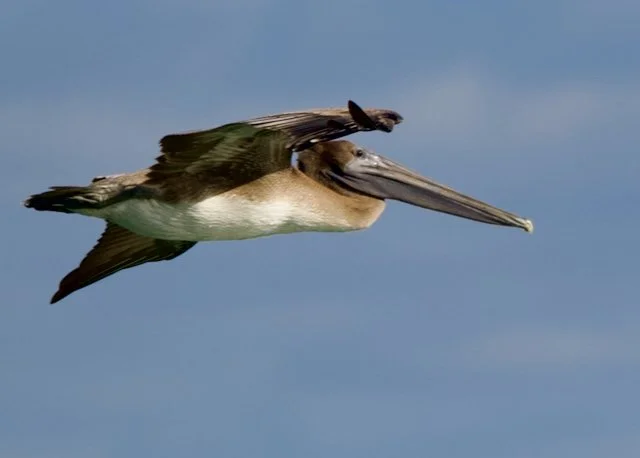
Speaking of scooping, brown pelicans have huge throat pouches (gular pouches) under their long bills that can hold up to three gallons of water along with a tasty piscine meal. They drain the water and then swallow the fish head first. Pelicans can also drink sea water aided by specialized desalination glands near their eyes. Desalinated water is then swallowed while a salty liquid residue drains down their long beaks.